This guide is for clinic managers, medical directors, program directors, and compliance leads at outpatient wound centers whose enterprise EHR handles complex wounds poorly. Only one product is profiled: Intellicure, the company that publishes this blog. Padding the field with vendors we have not evaluated would not help you. Instead, the evaluation criteria below are written so you can apply them to any wound-specific software you trial, including this one.
Where Does Intellicure Fit at a Glance?
- Intellicure: hospital outpatient wound centers whose enterprise EHR slows charting and weakens wound documentation; pricing on request (quoted directly by Intellicure, as of October 2026); automates medical supply ordering directly from the wound chart while working alongside the EHR you already run.
1. Intellicure
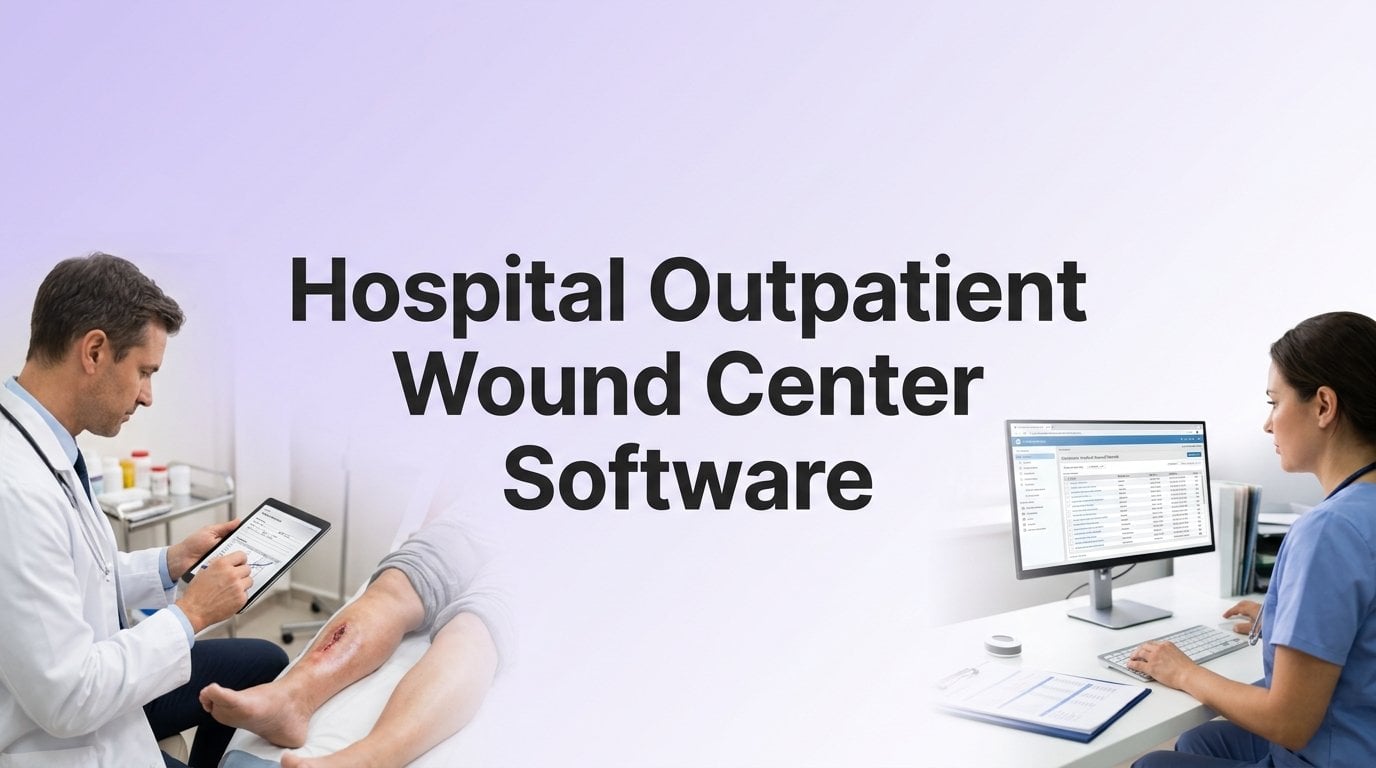
Intellicure is a wound-specific software suite: a wound care EHR, a mobile charting app, clinical workflow management, and automated medical supply ordering. For hospital wound centers, it is designed to work alongside the enterprise EHR rather than replace it, either as a SMART app inside that EHR or as a standalone wound care EHR interfaced to it. The buyer it fits is the wound center leader who has to defend coding, quality scores, and Targeted Probe and Educate (TPE) responses from documentation that the enterprise system captures poorly.

The problem it targets
A common purchasing mistake is to add a general EHR module and assume it captures wound-specific audit elements. Enterprise templates tend to flatten what reviewers look for: measurements and tissue description tied to a specific wound, the rationale for continuing a CTP application, documented failure of conservative care, offloading or compression adherence, and the clinical link between findings and the E/M level billed. When those elements live in free text or scattered flowsheets, they are hard to find during a TPE review and hard to aggregate for quality reporting. A wound-specific record is built around those elements, which is the core argument for a layer like this.
What it does distinctively well
The differentiator is supply ordering that runs directly from the wound chart. The clinician documents the wound and the plan, and the order for dressings and related supplies originates from that same record, carrying through to delivery at the patient’s door. Intellicure’s own data puts the savings at 45 to 60 minutes of nursing time per day, a vendor-reported figure worth verifying in your trial. That removes a separate ordering step and a common source of mismatch between what was documented and what was shipped. The other differentiator is the EHR-agnostic design: the intent is that you keep the hospital system for registration, enterprise billing, and inpatient care, and add wound-specific documentation on top.
Main features
- Wound care EHR with wound-specific documentation: structured fields for the elements reviewers and quality programs look for, so they are captured at the point of care instead of reconstructed later.
- Mobile app for bedside and clinic charting: lets clinicians chart where the wound is assessed, which cuts after-hours catch-up charting.
- Clinical workflow management: tracks visits, tasks, and follow-ups across the center so open items do not depend on individual memory.
- Automated supply ordering from chart to patient’s door: turns the documented plan into an order without re-keying.
How does it connect to your hospital EHR, and who owns setup?
Intellicure states that it integrates with any EHR capable of interfacing. It offers HL7 interfaces and FHIR-based SMART apps, including SMART apps for Epic, Oracle Health (Cerner), and PointClickCare, plus ADT, charge (DFT), document (MDM), and lab interfaces that send completed notes and charges back to the hospital system. Confirm which of these your hospital EHR supports before you commit, since that determines your IT workload and how notes reach the legal medical record. Ask who builds and maintains the interface, how long go-live takes, and whether your IT team or the vendor owns ongoing support. Day to day, the clinical team uses the charting tools, while the wound center manager typically owns workflow configuration and supply ordering oversight.
Who it does not suit
It is wound-focused only. It does not replace hospital-wide registration, enterprise billing, or inpatient charting, so a center hoping for a single system across the whole facility will still need the enterprise EHR. Running a second system also means a defined process for where the record of truth lives, how documents reach the hospital chart, and how users are provisioned. Treat any outcome or time-savings figure, including the vendor’s own, as a starting point to verify against your own visit volume during a trial.
Pricing
As of October 2026, Intellicure does not publish pricing; quotes are provided directly. Confirm the pricing model directly, including whether cost moves with clinician seats, locations, visit volume, or supply ordering activity, and whether interface work is billed separately.
Best for: Hospital outpatient wound centers whose enterprise EHR slows charting and weakens wound documentation.
Criteria to Check, Whatever You Shortlist
A pilot should test documentation under audit conditions, not just usability. These checks apply to any wound-specific system:
- Pull a TPE-style record set. Choose 20 recent charts for CTP or high-level E/M claims and see whether the software surfaces every element a reviewer would request, without manual reconstruction.
- Time a full visit. Measure charting minutes per patient against your current process, using your own clinicians and your own complex cases, such as multi-wound DFU and VLU patients.
- Check measurement continuity. Confirm wound measurements, photos, and healing trajectories carry across visits and can support healing rate reporting.
- Trace the data path. Verify what returns to the hospital EHR, in what format, and how fast, and who resolves a failed transmission.
- Test quality reporting. Confirm whether the wound-specific MIPS quality measures (QCDR measures stewarded by the US Wound Registry) can be produced from the captured data, and what you would still need to supply.
- Audit the ordering link. Compare a documented plan with the supplies actually ordered, looking for mismatches and how they are caught.
- Review access controls and support terms. Look at role permissions, audit logs, response times, and the exit path for your data.
Recommendations by Situation and Next Step
If your enterprise EHR is slowing charting and weakening the documentation you would need in a TPE review, shortlist Intellicure for a pilot. Its supply ordering from the chart and its EHR-agnostic design are the reasons to test it. If your center also needs hospital-wide functions such as registration, enterprise billing, or inpatient charting, treat it as a wound-specific layer on top of the enterprise system, not a replacement, and budget for the integration work that implies.
In either case, run the criteria above in a trial with your own charts and clinicians before signing anything. Ask Intellicure for the integration method, supported hospital EHRs, pricing model, and any outcome figures with sources. Click here to learn more.