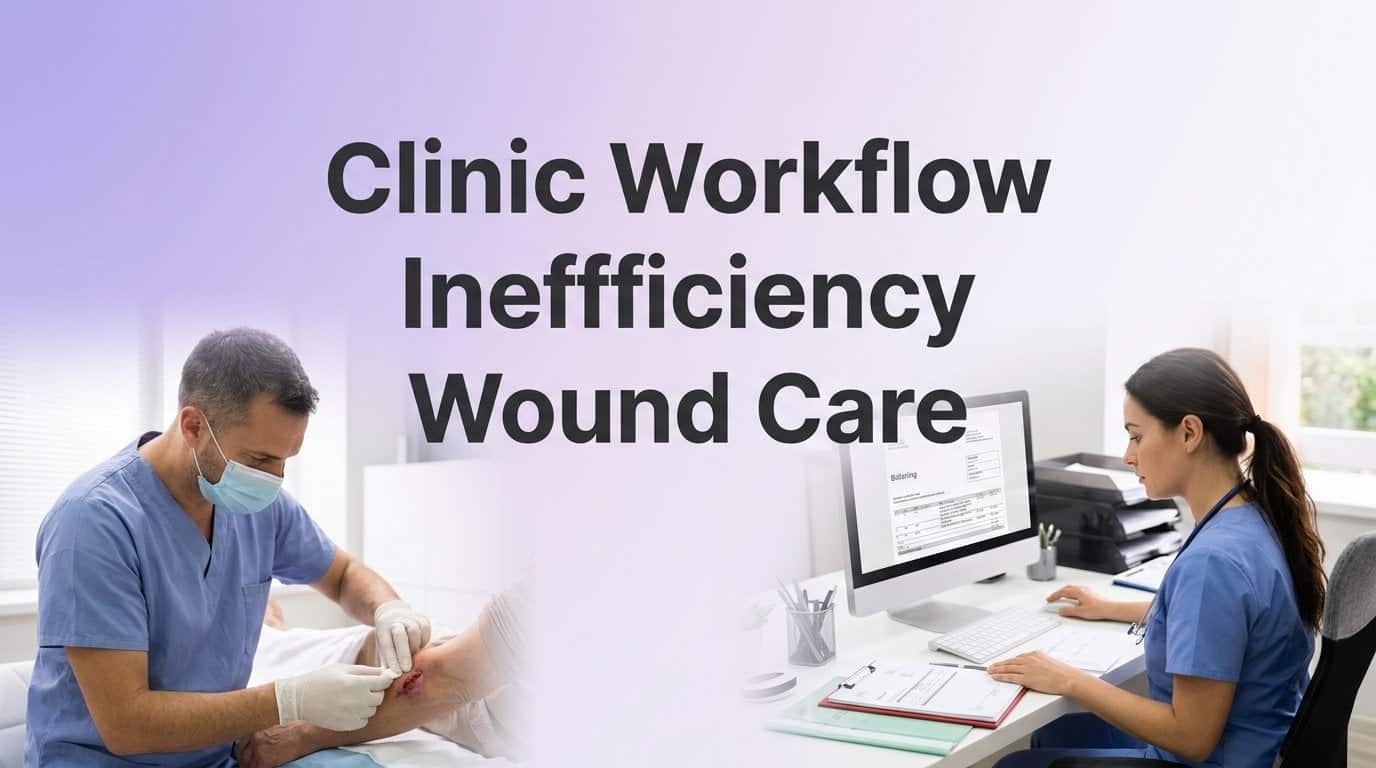
Practice workflow inefficiency in wound care almost always traces back to documentation friction, not staffing or patient volume, and it shows up as denied claims, missed E/M levels, and providers charting at 9 PM instead of at bedside. Practices that add staff or trim panel size to fix throughput are usually treating a symptom. The actual bottleneck sits in how wound data moves, or fails to move, from the patient’s bedside into a claim. This article breaks down where that friction originates, how it cascades into revenue and compliance exposure, and what a wound-specific workflow fix looks like in practice.
Where Does Workflow Inefficiency Actually Start in a Wound Care Practice?
Most EHRs were built for general medicine, not wound care. They have no structured fields for wound bed characteristics, undermining or tunneling, exudate type, or staging progression over time. Providers end up free-texting measurements and descriptors into a general notes field for every encounter, which takes longer to write and is nearly impossible to query later for trending, outcomes reporting, or registry submission.
That gap forces a second workaround: a separate wound-specific documentation system, a spreadsheet, or a paper flowsheet layered on top of the mandated facility EHR. Now the same wound gets documented twice, once in the system of record and once in whatever tool actually captures wound-specific detail. Every encounter carries this duplicate-entry tax, and it compounds across a multi-facility caseload where a provider might touch three or four different EHRs in a single day.
The third layer is supply ordering. In many practices, DME and dressing orders are not generated from the wound assessment itself. A provider or staff member has to re-key wound size, dressing type, and quantity into a separate ordering portal after the chart is already closed. That is a third pass at the same data point, done from memory or from flipping back through the note, and it is where orders get delayed, quantities get miscalculated, or supply choices drift from what the LCD actually supports. None of this is a staffing problem. It is a data-architecture problem: the same wound measurement gets typed three times into three systems that do not talk to each other.
How Does Charting Friction Turn Into Lost Revenue?
When charting takes too long, providers compress it, and the first thing to get compressed is the documentation of medical decision-making. Under time pressure, providers default to a lower E/M level rather than fully capturing the complexity, risk, and data review that would justify a higher one. This is systemic downcoding, not an occasional missed detail, and it happens visit after visit across an entire panel. Since the 2021 CMS E/M documentation revisions shifted code selection toward time or MDM rather than exam bullet-counting, practices that never rebuilt their templates around MDM capture are leaving revenue on the table on every encounter where complexity was actually present but never written down.
CTP and skin substitute claims carry a second, sharper version of this risk. Payers expect documentation of wound size at the time of application, a clear record of prior conservative care and its duration, and a stated medical necessity rationale tied to that specific product and that specific wound. CTP claims are a recurring focus area for Medicare Administrative Contractor Targeted Probe and Educate audits, and missing or inconsistent elements in this chain, especially measurement discrepancies between the wound assessment and the application note, are a common reason claims get flagged or denied outright.
Delayed charting compounds both problems. A provider who charts at the end of a shift, hours after leaving the patient, is reconstructing details from memory rather than recording them in the moment. Measurements get rounded, staging gets generalized, and MDM elements that were clear at bedside get flattened into vague language. These are exactly the omissions that surface later as denials, downcoding on post-payment review, or findings in a TPE sample. The revenue leak is not one bad note. It is a pattern built into the timing and structure of how documentation happens.
Why is the Problem Worse in Mobile Wound Care and Multi-Facility Rounding?
Mobile wound care providers rounding across SNFs, hospital outpatient departments, and private practice sites carry the documentation problem into a logistics problem. Without real-time access to a wound’s prior photos and measurements, a provider walking into a SNF room has no reliable way to confirm progress against the last visit except by re-assessing from scratch or trusting whatever was written in a chart that may live in a different system entirely. That re-assessment costs time at every stop, and it introduces measurement variability that makes healing rate calculations, and any registry or quality reporting built on them, less reliable.
Connectivity is its own constraint. Many SNFs and hospital units have limited or restricted network access for outside practitioners, so charting gets pushed into a batch process completed later, often after the provider has left the building or finished the entire route. That widens the lag between encounter and documentation for every patient on the route, not just the last one seen, and it is the direct mechanism behind the delayed-charting revenue risk described above.
The deeper structural issue is that a facility’s native system, PointClickCare in most SNFs, and the wound care practice’s own documentation tool are two separate records of truth for the same wound. A measurement entered in one does not appear in the other unless someone manually reconciles them. That reconciliation rarely happens consistently, which means the facility chart and the practice chart can tell slightly different stories about the same wound over time, a problem that becomes visible and costly the moment either record is pulled for audit, survey, or MIPS reporting purposes.
What Does an Efficient Wound Care Workflow Look Like?
An efficient workflow starts by moving data capture to the point of care instead of relying on a provider’s memory after the fact. Mobile charting that captures wound measurements, staging, and photos at bedside, and feeds them directly into a structured note, removes the free-text burden and produces a record that is immediately usable for coding, trending, and outcomes tracking. This is also the fastest way to close the gap that drives downcoding: when the assessment structure prompts for complexity and risk elements as part of normal charting, providers stop losing MDM detail to time pressure.
Supply ordering should be a byproduct of the assessment, not a separate task. When a wound assessment automatically generates the DME and dressing order, chart to patient’s door, the re-keying pass disappears entirely, and order accuracy improves because the order is built from the same measurement the provider just recorded rather than a recollection of it hours later.
Coding and compliance exposure need the same structural fix. Templates built around the elements payers actually require, wound size at CTP application, documentation of prior conservative care, medical necessity language, non-invasive arterial assessment where indicated, should surface those fields as part of routine charting rather than leaving providers to remember them case by case. The result is a chart that supports the E/M level actually earned and holds up under TPE review, because the required elements were captured as a normal part of the encounter, not reconstructed defensively after a denial letter arrives.
None of this requires ripping out a facility’s existing EHR. A wound care EHR that captures at the point of care and pushes structured data back into whatever system of record a facility mandates solves the duplicate-entry problem without asking a hospital or SNF to change its core platform.
How Should a Practice or Clinic Fix Workflow Inefficiency?
Start with measurement, not intuition. Pull a 90-day sample of documentation time per visit alongside denial reasons and coding levels billed. This tells you whether the actual bottleneck is charting speed, coding capture, or supply logistics, and each of those has a different fix. A practice that assumes it has a staffing problem when the real issue is CTP documentation gaps will spend money in the wrong place.
Interoperability should be a non-negotiable criterion in whatever solution follows. A wound-specific system built on FHIR/SMART-based integration can sit alongside a hospital or SNF EHR, pulling and pushing structured data rather than requiring a full platform replacement. This is what actually eliminates double entry: the wound assessment is documented once, at the point of care, and the structured data populates wherever else it needs to live.
Sequence the rollout instead of changing everything at once. A practical order:
- Mobile point-of-care charting first: this delivers the fastest return on provider time and immediately reduces the lag between encounter and documentation, which is where most downstream errors originate.
- Automated supply ordering second: once assessments are structured and captured digitally, ordering can be triggered directly from that data with minimal additional training.
- Coding and compliance templates third: layering MDM and medical-necessity prompts onto an already-adopted charting workflow meets less resistance than introducing new documentation requirements and new software at the same time.
Introducing all three simultaneously overwhelms staff and providers who are already stretched, and it makes it harder to isolate which change actually moved the needle on denials or charting time. A staged rollout gives you a clean before-and-after comparison at each step.
Treat the Chart-to-Claim Pipeline as a Fixable System
Workflow inefficiency in wound care is not a personnel problem or a volume problem. It is a documentation-architecture problem, built from free-text templates, duplicate entry, and disconnected supply ordering, and it is measurable and fixable once you trace it back to its source. The practices that get ahead of it are the ones that audit their own charting-to-claim pipeline before a TPE letter or a MIPS reporting deadline forces the issue. If your denials cluster around CTP applications, your E/M levels look consistently low for the complexity you know you’re managing, or your providers are charting well past the last patient of the day, the fix is structural, not a matter of working harder. Evaluate your workflow against a wound-specific EHR built for point-of-care charting, automated supply ordering, and multi-system interoperability, like Intellicure. Click here to learn more.