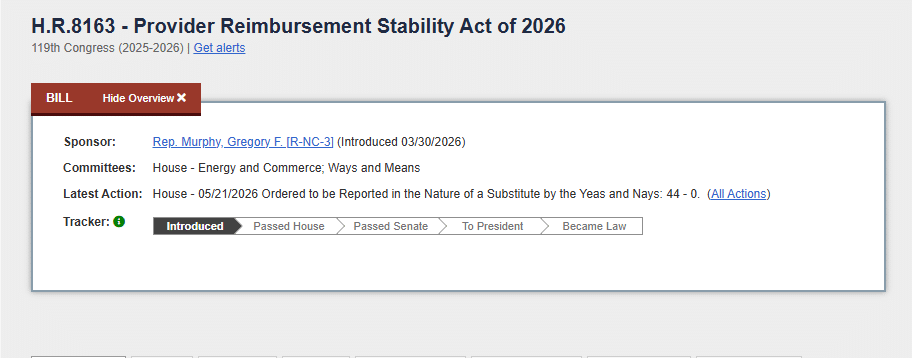
Here are some details about a new federal bill that aims to repair some of the underlying faulty components of the calculations that are threatening to close physician practices. The Provider Reimbursement Stability Act of 2026 (H.R. 8163) would update the budget neutrality threshold that requires any payment increases or decreases to offset one another; more fairly adjust incorrect billing codes under budget neutrality rules; require the Centers for Medicare & Medicaid Services (CMS) to more accurately and timely evaluate the costs of running a medical practice; and limit large payment swings in either direction.
Currently, physicians are in a gladiatorial arena fighting each other for a share of a very limited pot of money. The current structure creates winners and losers among physicians as CMS works around federally legislated mandates to redistribute payments within the allotted fee schedule budget. For example, with the current $20 million budget neutrality threshold, if CMS projects a $30 million increase in payments for a new or updated service, it must cut other physician payments by $10 million. Just for illustration, if surgeons get even a relatively small payment increase for a specific type of intervention, the payment to other physicians must be cut accordingly. The proposed neutrality fix at the center of the bill aims to reduce instances where relatively small payment updates trigger redistribution cuts in other parts of the fee schedule – in part by simply making the pot of money bigger.
H.R. 8163, introduced March 30 by Rep. Greg Murphy, MD (R-N.C.) and backed by numerous physician co-sponsors, would address outdated factors in payment calculations by:
- Raising the Medicare physician fee schedule budget neutrality threshold – unchanged since it was established in 1992 – from $20 million to $54.3 million, i.e., raising the cost cap on changes to the fee schedule to allow CMS to make larger payment increases for certain services without immediately triggering cuts to others;
- Starting in 2032, continuing to adjust the budget neutrality threshold “not less often than every five years,” using the Medicare Economic Index (MEI) used to calculate physician practice inflation;
- Providing updates to the direct costs used to calculate practice expense measures known as relative value units, or RVUs, and revisiting those at least every five years to better account for inflation; and
- Limiting positive or negative increases to the Medicare physician fee schedule conversion factor to no greater than 2.5% each year.
Passage of this legislation would be best coupled with one permanently tying Medicare physician payment to the MEI.